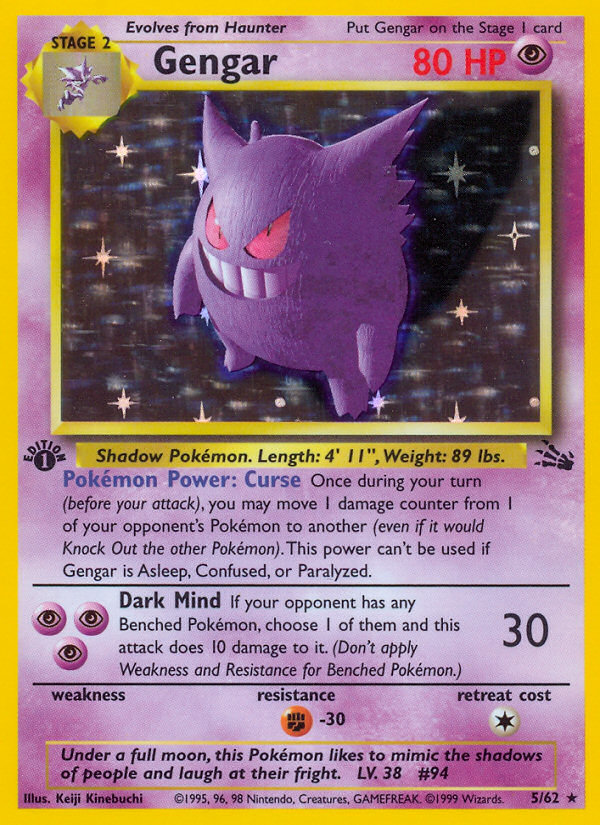
Fossil is the third set of the Pokemon Trading Card Game, released in 1999 right after Base Set and Jungle. It’s a small set, 62 cards, but a nostalgic one, and the 16 holographic rares still carry real money more than 25 years later. Here is what the top of the set looks like right now, pulled from our Fossil set page.
The most valuable Fossil cards
| Card | Market price |
|---|---|
| Gengar (Holo) | $211 |
| Dragonite (Holo) | $179 |
| Moltres (Holo) | $70 |
| Articuno (Holo) | $68 |
| Haunter (Holo) | $52 |
| Zapdos (Holo) | $50 |
| Raichu (Holo) | $48 |
| Aerodactyl (Holo) | $43 |
Those numbers are a snapshot, and vintage prices move, so every card page carries the live market price and a history graph, and you can set a price alert to hear about a dip. The ranking itself has been stable for years: Gengar and Dragonite lead, then the three legendary birds, then the rest of the holo slate.
One note on what these prices mean: they are for raw, ungraded singles from the main set, which is what EvoMarket deals in. Graded and slabbed copies trade separately and usually higher. Curious how high the very top of the Pokemon market goes? See Is there a $1,000,000 Pokémon card?
Why Gengar leads
Gengar is the collector’s favorite of the set and has been for a long time. The artwork is one of the most recognizable in the whole vintage run, Gengar is a perennial fan-favorite Pokemon, and it saw real competitive play back in the day. Dragonite sits just behind it for similar reasons, a beloved Pokemon with a clean holo. After those two, the value tracks popularity almost exactly, which is why Moltres, Articuno, and Zapdos cluster together right underneath.
Condition is most of the price
On a 25-year-old card, condition is the single biggest lever on what you pay. A Fossil holo in Near Mint can sell for several times what the same card grades at in Moderately Played, because clean vintage holos are genuinely scarce. Watch for the usual vintage wear: edge whitening, surface scratches on the foil, and print lines. If you are buying to hold rather than to grade, buying a step down in condition is often the best value on the whole page, since the artwork is identical and the price gap is large.
1st Edition versus Unlimited
Fossil had a 1st Edition print run (the small "Edition 1" stamp on the left of the art) and a larger Unlimited run. The prices in the table above are for Unlimited holos, which is what most sellers stock. 1st Edition copies are scarcer and command a real premium, especially for Gengar and Dragonite. On EvoMarket the seller picks the edition on the listing, so check which one you are looking at before you buy, and filter for it if you specifically want one or the other.
Buying tips
- Decide grade-worthy or player copy first. If you want a card to grade, pay up for Near Mint and inspect the photos. If you just want the art in a binder, a Lightly or Moderately Played holo is a fraction of the price.
- Confirm the edition. A 1st Edition stamp can swing the value a long way, in both directions, so know which you are buying.
- Use the price history. Vintage staples drift rather than spike, so the graph on each card page tells you whether you are buying into a run-up or a quiet stretch.
You can see the whole set, holos and commons, on the Fossil set page, or browse Pokemon singles across every set our stores carry.